
Space shuttles (Shuttles)
A convenient way to ferry people and materials to and from stations (ground-based or space-based), as well as transport over distances beyond the reach of the teleporter is the space shuttle, or ‘shuttle’ for short. To make it practical to use shuttles for exploratory missions over longer distances, using e.g. a starship as base of operations, several OCC shuttle types have been outfitted with hyperdrives. The exponential dependence of the singularity size on the mass of the object to be propelled makes it possible to incorporate hyperdrives into the shuttles without demanding an excessive volume of space.
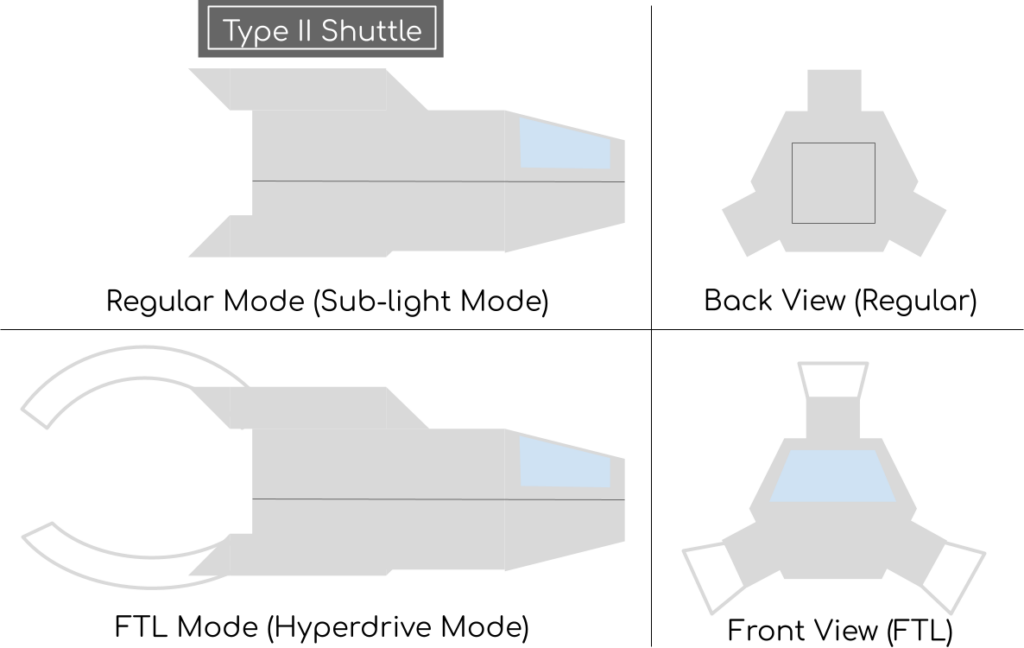
Because shuttles are often required to dock at variously sized ports and to preserve space when docking in a launch bay, the hyperdrive nacelles of most OCC shuttles are retractable. By default, the nacelles are retracted, and they are expanded when the shuttle needs to use its hyperdrive. The schematic representation of a Type-II Shuttle to the right depicts this.
In contrast, the nacelles of a starship are fixed, because of the size of the mechanism needed and to maintain structural integrity.
The picture below shows the layout of a ‘Runabout’ shuttle, including the various technical areas. The Runabout’s domestic facilities make it ideal for medium-term missions (up to several weeks).
