
Starship weaponry
Space is big, and so are the hazards that a starship may encounter. For example, the ship might encounter asteroids of various sizes that need to be destroyed. To deal with some of these hazards, Omega Cyberspace starships are equipped with powerful weapons. Galaxy-class starships like the Event Horizon are equipped with the following weapons:
- Particle-beam cannons, or ‘beam cannons’ for short.
- Intelligent, self-guiding drones.
- Railgun turrets.
> Beam cannons
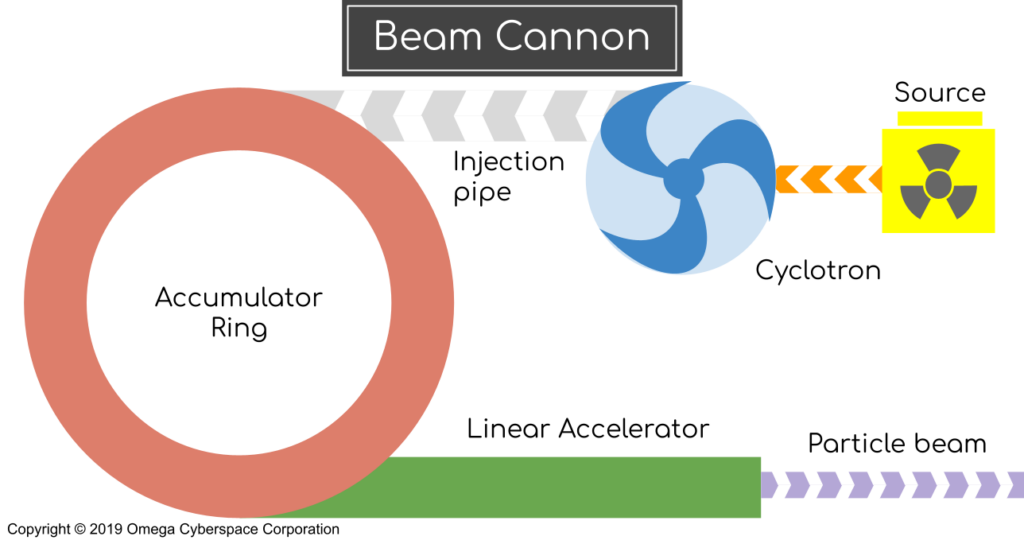
A cyclotron accelerates kaons and pions and injects the particles into an accumulator ring. The particles are stored there, and the weapon is now ready for use. When activated, the particles are loaded into a linear accelerator. The linear accelerator hurls the high-intensity particle beam at the designated target.
Self-cooling beam
To prevent decoherence of the beam, the particles in the beam are prepared in an excited state where they radially emit photons. This ‘cools’ the beam, allowing the beam to hit targets at larger distances and with greater precision. In addition, this makes for a more spectacular sight and allows visual tracking of the beam, as the emitted radiation is in the visual spectrum.
The downside of letting the particles emit radiation is that the beam loses energy the further it progresses. However, if the beam should miss its target, this also prevents the beam from causing collateral damage to the surroundings, as the beam dissipates at some point. But, as the emitted photons are in the eV range, they barely slow down the beam, which is in the GeV range. Hence, for practical combat purposes, this does not limit the range of the beam.
> Drones
Unlike regular torpedos, which cannot be controlled after they have been launched, drones are programmed with an advanced artificial intelligence that enables them to destroy targets with unprecedented efficiency. Combined with rudimentary sensors, drones are able to actively seek out weak points in the target to maximise the impact. Drones are also able to communicate with each other, allowing them to dynamically determine the optimal impact pattern to reach the desired degree of destruction within the target. Variable detonation circuits make the yield of each drone tunable and enable the remote self-destruct sequence to be activated. Because the drones can guide themselves, tactical officers may focus on other tasks after firing the drones. Drones are launched from so-called ‘drone platforms’.
> Railgun turrets
Railgun turrets allow to rapidly shoot up smaller targets. The turrets operate using the ‘Gauss cannon’ principle: Each turret is essentially a powerful (electro-)magnetic accelerator that propels electromagnet projectiles. The accelerator operates by using a series of coupled electromagnets. When one magnet is set to repel the projectile, the next one is set to attract it. Once the projectile has passed the attracting magnet, the polarity of each magnet is switched, accelerating the projectile by 1) magnetic repulsion of the poles of the electromagnet of the accelerator and the projectile, and 2) magnetic repulsion as a result of Faraday induction within the projectile. To make sure each next stage continues to accelerate the projectile, the spacing between consecutive magnets must continuously increase, correcting for the flight-time of the projectile between the magnets. This is needed to ensure that, when the projectile arrives at the next magnet, it is attracted by it.
Visual tracking of the projectiles is possible, because, as they are being accelerated, the projectiles are inductively heated to a temperature where they start to ‘glow’ (technically speaking, they become a black-body-like radiator with a maximum frequency in the visual spectrum). If desired, the projectiles can be fitted with an explosive charge to increase their impact. The detonation circuit of the explosive must be such that it is not affected by the magnetic fields to which the projectile is exposed.