
Life support systems
To make a starship a home-away-from-home, it is vital that crew members can walk about the ship freely without having to wear protective gear and oxygen masks. Moreover, the ship must be able to sustain the crew without the need to resupply often. To accommodate this, OCC starships come equipped with advanced life support systems:
- Artificial gravity systems.
- Carbon extractor, supplemented by oxygenating plants throughout the ship.
- Natural lighting.
- An advanced waste reprocessing plant.
> Artificial gravity
An important, and often underestimated, feature is the need for (artificial) gravity. Studies have shown that when the human body is exposed to low-gravity conditions for an extended period of time, the muscles start to wither away. So, although we may sometimes dismay gravity, it is in fact vital to keep the human body functioning. There are several ways to mimic gravity, such as rotating the ship to generate a centrifugal force. However, this imposes radical constraints on ship design, that always comprimise the stress that the hull will be able to endure. This severely limits the speed at which the ship can travel, both in hyper-curved space and normal space. Indeed, it is questionable whether the ship would be able to travel through hyper-curved space at all!
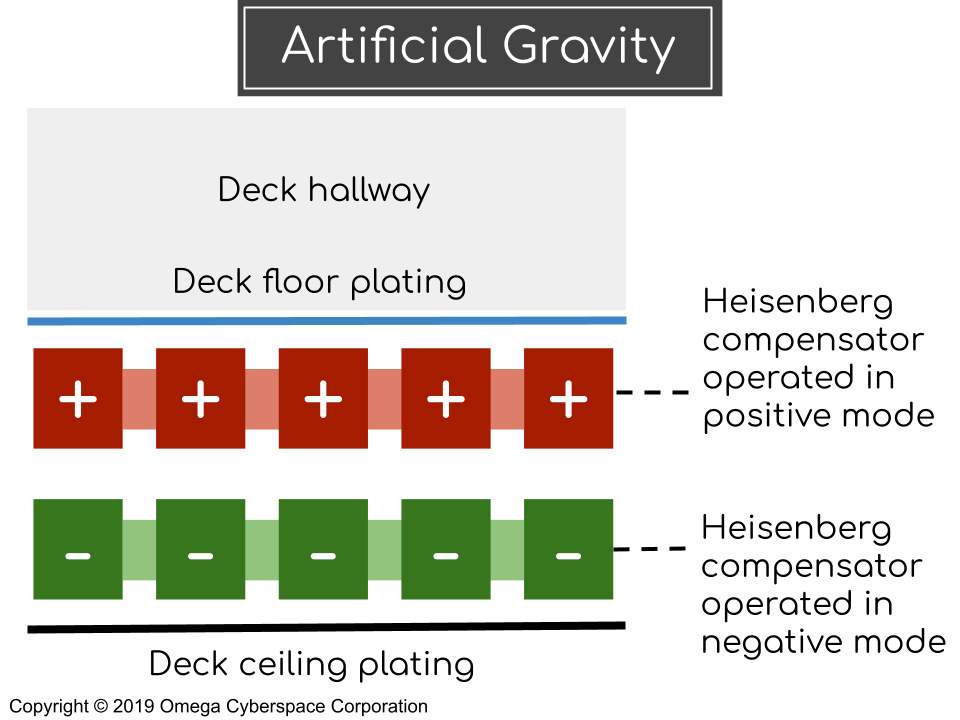
Fortunately, OCC scientists discovered a better way to simulate gravity. It is known that gravity acts on objects by exchanging the mediating particles of the gravitational force: gravitons. Granted, generating gravitons is no easy matter. However, OCC scientist found a way to ‘cheat’: by using the fact that the vacuum is not empty. Particles continuously pop in and out of existence, with their lifetime t determined according to the Heisenberg uncertainly relation ∆E∆t≤h. Here, E is the energy of the particle (including its mass), h is the Planck constant. As gravitons are massless, they can live for a pretty long time. The trick is to get them out long enough to interact with matter. A device called a ‘Heisenberg compensator’ places a bias on the vacuum that forces gravitons to remain in the physical realm long enough to mediate a gravitional force. To prevent the gravitons from attracting matter on the deck below the plating, a second device is placed underneath the first, that fortunes anti-gravitons. Note: This device is also used to land the ship by compensating for the gravitons that are produced from the gravitational pull of the planet.
> Carbon extractor
It is unpractical to carry around huge oxygen tanks, next to the fact that these are highly flammable. To make sure the crew has enough oxygen, OCC scientists turned to nature. Inspired by the fact that most plantlife can extract carbondioxide and convert it to oxygen, they created the Carbon Extractor. This device performs exactly this process: convert carbondioxide to its basic atomic constituents: oxygen and carbon. The oxygen is released back into the ships ventilation systems and the carbon is stored for use by 3D printers to construct materials.
Of course, when it comes to providing oxygen, it is unwise to ‘bet all your money on one horse’ as they say. Therefore, the carbon extractor is supplemented by oxygenating plants throughout the ship, and, yes, several large tanks of oxygen. In case the ships’ oxygen supply appears to run out and the carbon extractor is not available, there is an oxygen recombination plant, that can extract oxygen atoms from interstellar gas and recombine them into the so-desired oxygen molecules.
> Natural lighting
A lot of processes in the human body are driven by exposure to sunlight and the existence of a day/night rithm. Any healthy starship environment needs to take this into account. To provide this, several areas of the ship are fitted with sunlight-mimicking lamps. Because plants also require sunlight to flourish, the lamps are mostly located at places where plants are placed. Because long-term exposure does more wrong than good, locations where crew members spend prolonged periods of time, such as the bridge and working stations, do not have such ‘natural’ lighting. Each crew quarter also has a natural light that can be enabled if, e.g. the crew member is working a night shift and has not been exposed to sunlight for some time.
The day/night rithm is automatically controlled by the computer and runs in 24-hour cycles (12 hours ‘day’, 12 hours ‘night’). During ‘night time’, natural lights are switched off or switched to a non-natural mode and most of the other lighting throughout the ship is dimmed and tuned to exclude blue light.
> Food
Most starships feature an hydroponics bay to grow plants and vegetables for consumption. However, this is often not sufficient to feed the crew or to provide a sufficiently varied diet. Rations are able to provide sufficient nutrician, but lack taste or any culinary experience. A recent breaktrough in genetic and molecular engineering provides the solution, by means of so-called ‘protein resequencing’. The process takes a specially prepared ‘goo’, constisting mainly of different peptides and minerals, that is mixed with stabilisers and irridiated with low-energy gamma photons, before being fed to a 3D-printer that appropiates the newly formed molecules into ‘real’ food. Crew members can enjoy resequenced lasagna, potato stew, grilled steak, salads, and much more. The possibilities are nearly endless, as the protein resequencers can replicate practically all known dishes. In addition, the Event Horizon still has an hydroponics bay to supplement the protein resequencers.
> Waste reprocessing
Waste production is an important issue in all societies, and even more onboard a ship. Because resources are limited, responsible and smart waste processing is an absolute requirement. To this end, OCC starships are equiped with several innovations.
All waste to divided into categories, depending on the material it contains. Some of the biological waste is suited for a breakdown into resequencing peptides, so it can be repurposed for use in the protein resequencers. Plastics can often be recycled.
The most important and challenging resource is water. Waste water is filtered and distilled to be re-used in the ship. It is impractical to collect all water that has been reclaimed from air dehumidifiers to be added to the ship’s primary water supply, so it is stored locally to be used by crew members to tap a glass of water or to water the plants. Like with oxygen, in case of emergency, the ship has a processing plant to gather molecular of even atomic hydrogen from interstellar clouds and combine it with oxygen to form water.