Hyperdrive
The vast distances in space necessitate faster-than-light (FTL) travel for practical applications. However, these speeds are forbidden by Einstein’s theory of special relativity. To circumvent this restriction, OCC scientists devised a way to ‘cheat’ nature: by curving space itself. This ensures that the local speed never exceeds the speed of light, but globally allows to cover vast distances in a practical time. The hyperdrive allows ships to make use of this.
> Theoretical concepts
The hyperdrive utilyses focussed, polarised tachyon beams to create a space-time singularity. The beams are pulsated to create a singularity that continuously contracts and expands space-time. The ship’s engine is tuned to the eigenfrequency of the resulting space-time waves (which are not unlike gravitational waves), allowing it to ‘ride the waves’, thereby propelling the ship at speeds that can easily exceed the speed of light without:
- Violating special relativity.
- Requiring an engine that can propel a (very) massive ship to extreme speeds.
- Causing problems with inertia. Even if it would be possible to propel a ship to the speed of light quickly, the resulting inertial forces from the acceleration would crush anything inside the ship (or even the ship itself). The same would hold for deceleration after exiting FTL travel. By using the hyperdrive, space-time itself expands along with the ship when the hyperdrive is disengaged and the singularity collapses. Because of this, the inertial forces resulting from deceleration to normal speed are neglegible.
> Technical realisation
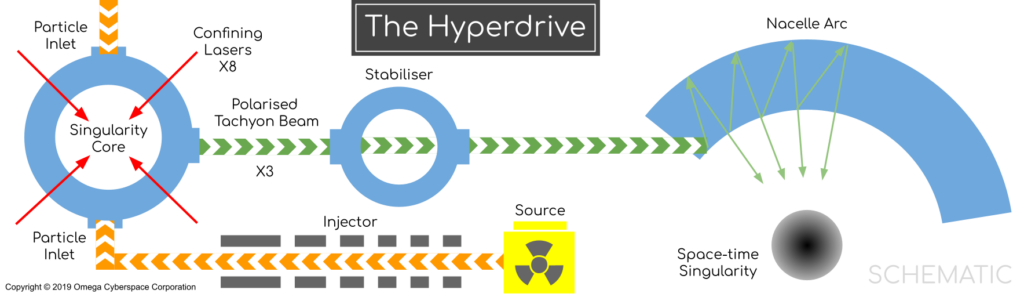
Two linear accelerators each create a particle beam. The beams collide in the center of the singularity core and form a tachyon plasma. Eight fine-tuned lasers are directed at the plasma to confine and polarise it. The polarised, hyper-exited tachyon particles are extracted via three beam lines and are guided via a stabiliser to the hyperdrive engines. The stabilisers help to maintain the energy balance while the transportation beam lines are designed to maintain coherence.
Once a beam reaches one of the engines, the beam is ‘bounced’ through the nacelle arc. The arc is made such that tachyon particles are fully reflected on the outer surface of the arc, and of a material that partially transmits the beam on the inner surface. This sends a coherent, isotropic tachyon beam to the center of the hyperdrive engine section, where the beams of the three nacelles meet to create a space-time singularity.
The singularity curves space-time around it. Space-time is contracted more strongly at the stern of the ship, so the tendency to expand again is greater there, creating a net forward movement. Terminating the tachyon beams collapses the singularity, causing the ship to exit hyper-curved space-time.